

“Sleep is the single most effective thing we can do to reset our brain and body health each day.” - Matthew Walker
Sleep when you’re alive
A decade ago, “I’ll sleep when I’m dead” was the mantra. Now millions of us wake up in the morning, reach for our phone and check our “sleep score”. Millions of us realise that sleep can impact our health as powerfully as how we eat or move that day. Sleep is when our body repairs tissue, consolidates memories, regulates hormones, and clears out metabolic waste from the brain - processes that keep you physically healthy and mentally sharp1. All good reasons to embrace sleeping through a third of your life.
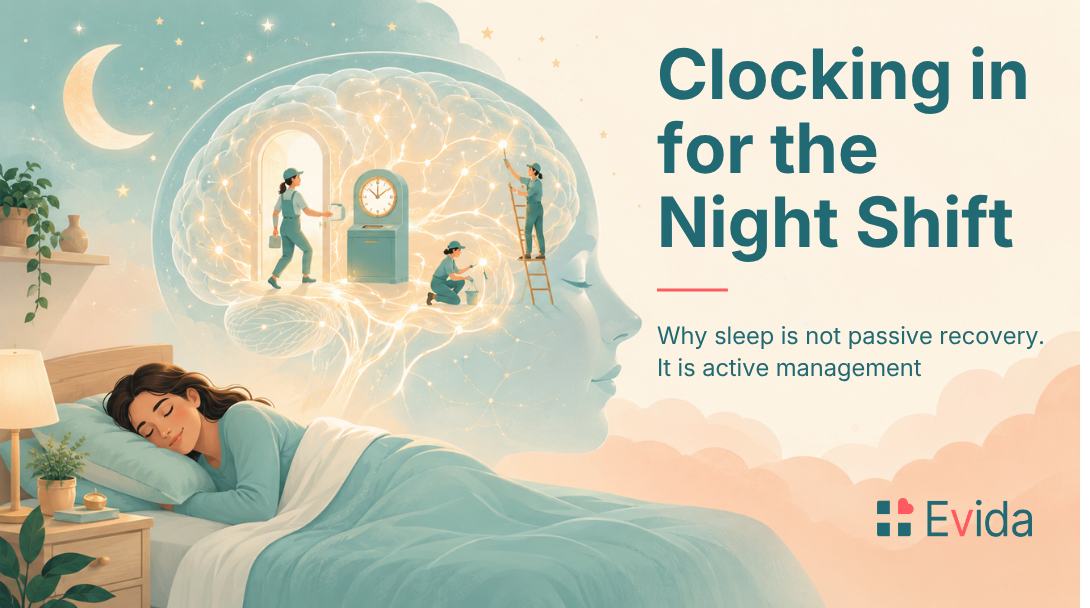
Yet, despite this modern knowledge, sleep remains the first casualty of a busy schedule - myself included. We stay up late to finish work. We scroll for a little longer. We squeeze in one more episode. We tell ourselves we will “catch up” at the weekend. But sleep should not be so expendable as it isn’t a case of your body clocking out - it’s clocking in for one of its busiest, most regenerative shifts of the day.
Thanks for reading Evida's Substack! Subscribe for free to receive new posts and support my work.
Subscribe on SubstackCatching up at the weekend can make you feel more human, but it is not a perfect reset button. Sleep debt builds when we repeatedly get less sleep than our body needs, and although extra rest can help, research suggests weekend recovery sleep does not fully reverse the effects of chronic short sleep2. The better aim is not to “repay” sleep once a week, but to protect it more consistently across the week.
What are we busy doing when we sleep?
When sleep is working well, your body moves through different stages across the night. In lighter sleep, you transition away from wakefulness. In deeper sleep, the body prioritises physical restoration, immune function, and repair. In REM sleep, the brain becomes more active, supporting memory, learning, emotional processing, and creativity.3
All of this is shaped by two powerful systems, known as the two-process model.4 The first is sleep pressure, driven partly by adenosine, a chemical that builds up the longer we are awake and makes us feel increasingly tired. The second is the circadian rhythm, which helps time our alertness and sleepiness across the 24-hour day, with melatonin rising in the evening as darkness signals that night is approaching. Cortisol then tends to rise towards morning, helping the body prepare to wake. Good sleep happens when these systems are working with each other, not fighting against late caffeine, bright light, heavy meals or irregular routines.
The circadian rhythm - why it matters
“Circadian” comes from the Latin circa diem, meaning “about a day” - fitting, since our internal clock runs roughly across 24 hours. This master clock lives in the suprachiasmatic nucleus (SCN), a brain region that controls sleep and wakefulness5 . It’s kept in sync by external time cues called “zeitgebers,” the most powerful being light: special cells in the eye detect brightness - and signal straight to the SCN, so even a brief flash can register as “daytime.” That makes when we’re exposed to light just as important as how much, a key factor in sleep health.
Your circadian rhythm is your own. You may be a night owl, used to working late and getting up late, or a morning lark - starting the day early whilst others are sleeping. There is no right or wrong, but there are clear types. Figure out yours and optimise for yourself - not the societal average. This will also change over the course of your life. Newborns need up to 17 hours a day; by adulthood, that settles to a steady 7–9 hours a night for life6. Sleep, in other words, is a moving target that changes as we grow.
Quality, not just quantity
Brits are on average sleeping more - average UK sleep has increased 43min to over 8 hours compared to 7h 23 in the 1970s7. But averages hide a lot. If that does not reflect your night, duration may still be the first thing to fix. Once you have done that, turn to quality.
Ultimately, the advice on good sleep hygiene comes down to lifestyle factors that avoid disrupting the two-process model and our natural circadian rhythm:
Light: Blue light suppresses melatonin for twice as long as green light, and is why screen time (which is associated with blue light) is not recommended before bedtime.
Caffeine: Caffeine works by blocking adenosine’s effect, which is why it can delay the feeling of tiredness
Food: Eating late can act as a zeitgeber - a signal to the brain to keep digestion going, which can disrupt the circadian rhythm.
Temperature: A cooler environment helps our circadian rhythm by mimicking the natural evening temperature drop our ancestors experienced, and is associated with melatonin production
That is why good sleep hygiene is less about perfection and more about rhythm. A few habits do most of the heavy lifting:
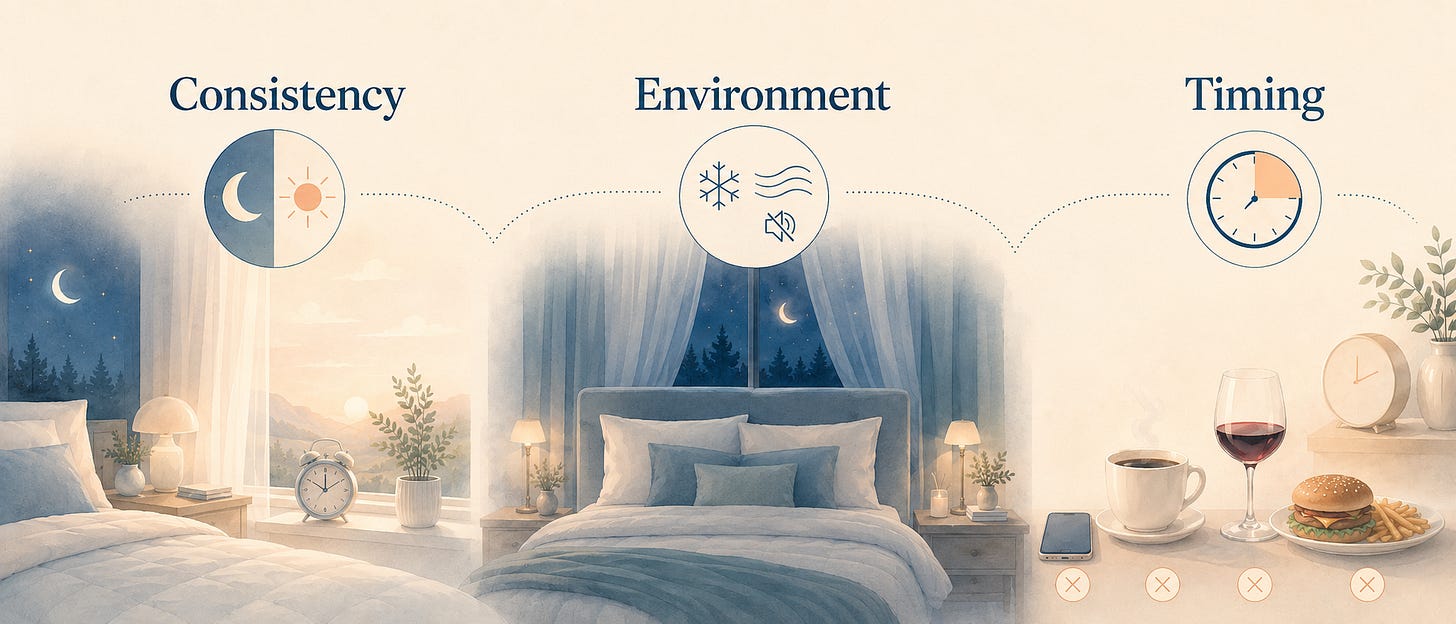
Consistency: Try to wake up and go to bed at roughly the same time most days. Your body clock likes predictability.
Environment: Keep your bedroom cool, dark and quiet. A cooler room helps support the natural drop in body temperature that prepares us for sleep.
Timing: Reduce the main disruptors in the final couple of hours before bed where possible: caffeine, alcohol, heavy meals, bright screens and stressful work.
None of this needs to be extreme. The goal is not to engineer the perfect night. It is to remove a few of the things that make sleep harder than it needs to be.
You’re in control
Your smartwatch can tell you how you slept. But no device can do the sleeping for you. That part is still yours - and the good news is, it does not take perfection. It just takes a few small, deliberate choices, wrapped in a consistent night time routine, to give your body what it needs to rest and repair. Protect a little of your sleep tonight, then protect it again tomorrow night, and feel the difference.
Disclaimer: This content is for educational and informational purposes only and is not intended as a substitute for professional medical advice, diagnosis, or treatment.
Resources:
Eugene, A., Masiak, J. (2015) ‘The Neuroprotective Aspects of Sleep’, MEDtube Sci. (Accessed: 6 July 2026)
Dudley, K. (2019) ‘Weekend catch-up sleep won’t fix the effects of sleep deprivation on your waistline’, Harvard Health Publishing. Available at health.harvard.edu. (Accessed: 6 July 2026)
Suni, E. (2025) ‘What happens when you sleep’, Sleep Foundation. Available at sleepfoundation.org. (Accessed: 6 July 2026)
Borbély A. (2022) ‘The two-process model of sleep regulation: Beginnings and outlook’, Journal of Sleep Research. (Accessed: 6 July 2026)
Herzog, E., Hermanstyne, T., Smyllie, N., Hastings M. (2017) ‘Regulating the Suprachiasmatic Nucleus (SCN) Circadian Clockwork: Interplay between Cell-Autonomous and Circuit-Level Mechanisms.’ Cold Spring Harbor Perspectives in Biology. (Accessed: 6 July 2026)
‘About Sleep’, CDC. Available at https://www.cdc.gov/sleep/about/index.html. (Accessed: 6 July 2026)
Lamote de Grignon Pérez, J., Gershuny, J., Foster, R., De Vos, M. (2019) ‘Sleep differences in the UK between 1974 and 2015: Insights from detailed time diaries.’ Journal of Sleep Research. (Accessed 6 July 2026)
Thanks for reading Evida's Substack! Subscribe for free to receive new posts and support my work.
Subscribe on Substack