

“The food you eat can be the safest and most powerful form of medicine.” - Ann Wigmore
You keep hearing that you need to lower your cholesterol - but apparently not the “good” kind, only the “bad” kind. So, wait… do you want your cholesterol number to be high or low? And what does any of this actually mean?
Suddenly breakfast feels like a medical decision.
Cholesterol matters because it is closely linked to cardiovascular disease, which remains one of the biggest causes of death and ill health in the UK(1). Most of us think that cardiovascular disease is just about the heart but it’s a lot more than that. It’s an umbrella term for conditions affecting the heart PLUS the vast network of blood vessels or “vascular system” that supply all organs and tissues in the body. When we are aiming to manage cardiovascular risk factors, we are not just protecting the heart, but we are also protecting every other blood vessel travelling throughout our bodies.
Alongside your weight, blood pressure, and blood sugar control, cholesterol plays an important role in your cardiovascular health. Cholesterol is a risk factor that we can measure, put into context and, most importantly, often change.
Cracking the cholesterol code
Cholesterol itself isn’t the enemy. It is a waxy substance that your body naturally makes in the liver & it serves as an indispensable structural building block for cell membranes, a foundation for essential hormones and vitamin D, and a key component in digesting dietary fats.
Too much cholesterol can be harmful & that is why we need to be mindful of it in our diet.(2) The question is understanding the different types of cholesterol and then what we can do about it:
LDL particles carry cholesterol from the liver to tissues around the body. When there are too many circulating LDL particles, cholesterol can accumulate within artery walls and contribute to atherosclerosis - the process underlying many heart attacks and strokes. That is why LDL is often called “bad” cholesterol.
HDL helps transport cholesterol back towards the liver and is therefore commonly called “good” cholesterol. But the labels can be misleading: a high HDL result does not simply cancel out a high LDL result.
Non-HDL cholesterol captures the cholesterol carried by LDL and other potentially atherogenic particles, which is why clinicians often pay particular attention to it.
Triglycerides are another type of fat circulating in the blood and provide additional information about metabolic and cardiovascular health.
No single number should be interpreted alone. Your results make most sense when combined with factors such as your age, blood pressure, smoking status, blood sugar, medical history and family history to understand your overall cardiovascular risk.(3) It’s also why the numbers should be read by a clinician, not AI.
Genes versus lifestyle
Cholesterol is influenced by both our genes and our environment - and the balance is different for everyone.
Some people inherit conditions such as familial hypercholesterolaemia(4), which can cause markedly raised LDL cholesterol from an early age. Many more inherit smaller genetic differences that influence how their bodies produce and clear cholesterol. However, an empowering truth for 80% of us is that most cholesterol issues are not set in genetic stone.
Lifestyle matters enormously. What we eat, how active we are, whether we smoke, our weight and other aspects of metabolic health can all influence our lipid profile and our wider cardiovascular risk. For many people, changing these factors can produce meaningful improvements.
A striking example of just how much is under our influence comes from North Karelia in Finland. In the early 1970s, the region had exceptionally high rates of cardiovascular disease. A large-scale public-health programme targeted smoking, blood pressure and diet, including a move away from diets rich in butter and high-fat dairy towards more unsaturated fats and plant foods.
The results were remarkable. Over the following decades, coronary mortality among middle-aged men fell by more than 80%. Researchers estimated that around two-thirds of the reduction could be explained by changes in major risk factors, with the large fall in serum cholesterol playing a particularly important role; improvements in medical treatment also contributed.(5)
It wasn’t one superfood, supplement or short-lived diet. It was sustained change in everyday behaviours and the environment around them.
What does a cholesterol-friendly plate look like?
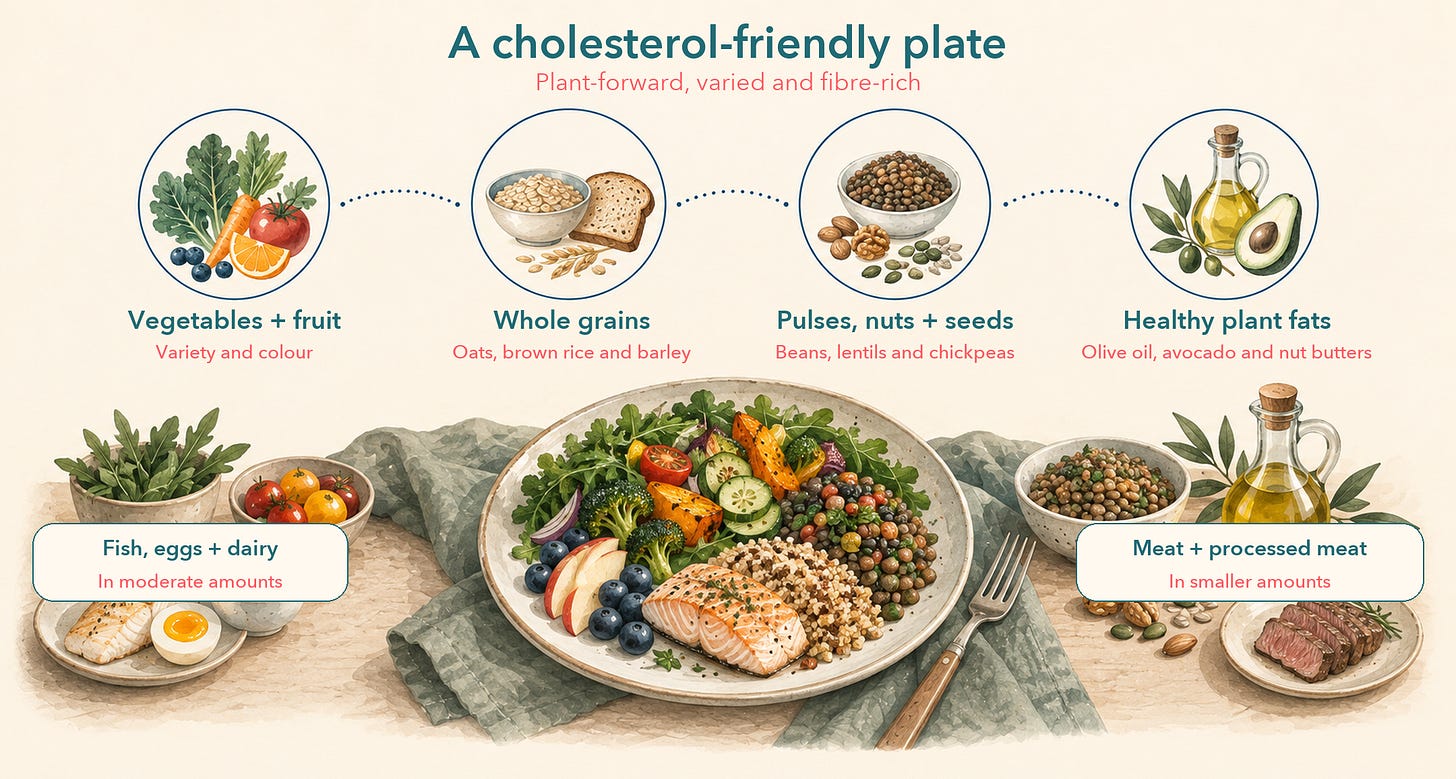
A cardioprotective (“cholesterol-friendly”) plate is full of variety, leaning into plant-based and fibre rich feeds such as vegetables, fruit, wholegrains, pulses, nuts. Think plant-forward, rather than necessarily plant-only:
Vegetables and fruit - aim for variety and different colours
Whole grains - such as oats, wholegrain bread, brown rice, barley and quinoa
Pulses - beans, lentils, chickpeas and peas
Nuts and seeds - including walnuts, almonds, chia and flax
Healthy plant fats - such as olive oil, avocado and nut butters
Fish, eggs and dairy - in moderate amounts
Meat and processed meat - generally in smaller amounts, particularly processed meat
There is meaningful evidence behind this approach. In trials of the Portfolio Diet - a more targeted eating pattern combining nuts, plant proteins, viscous soluble fibre and plant sterols - LDL cholesterol fell by around 17% compared with a low-saturated-fat control diet.(6) Mediterranean-style dietary patterns have also been associated with fewer cardiovascular events in people at elevated cardiovascular risk.(7, 8)
Health hack: make healthier eating easier
You don’t need to completely redesign your diet. Try these three simple changes instead:
1. Make one swap
For most people, saturated fat has a greater influence on blood LDL than dietary cholesterol itself. A useful focus is therefore what replaces saturated fat: swapping some butter, fatty or processed meat, pastries, coconut oil and palm oil for unsaturated fats and fibre-rich foods
Swap butter for olive or rapeseed oil. Swap a processed-meat lunch for fish, beans or lentils. Swap a refined cereal for oats or another wholegrain option. One small substitution, repeated often, can matter more than a perfect diet that lasts a week.
2. Add friction to the foods you want to eat less often
Willpower is difficult when the crisps are sitting on the kitchen counter.
Instead, make the less healthy choice slightly harder. Don’t keep snacks you tend to overeat within arm’s reach. Buy smaller packs rather than multipacks. Put healthier options somewhere visible and convenient.
The aim isn’t to ban foods. It is simply to make the healthier decision the easier decision.
3. Eat the rainbow
Look back at the cardioprotective plate above and ask a simple question: how many different colours can you add this week?
Different fruits, vegetables, pulses, nuts and seeds bring different combinations of fibre, micronutrients and plant compounds. Rather than focusing only on what to remove from your diet, challenge yourself to increase the variety of plants you eat.
Red peppers, orange carrots, green broccoli, blueberries, purple cabbage - your plate doesn’t need to be perfect. Just make it a little more colourful.
Takeaway
A cholesterol result is useful, but it isn’t a verdict on your health.
Understand the numbers. Put them in the context of your overall cardiovascular risk. Then identify the next action that is most likely to make a difference - whether that means changing what you eat, becoming more active, addressing another risk factor or discussing results with a clinician. It’s not the number that matters but what you do next.
Thanks for reading Evida's Substack! Subscribe for free to receive new posts and support my work.
Subscribe on SubstackDisclaimer: This content is for educational and informational purposes only and is not intended as a substitute for professional medical advice, diagnosis, or treatment.
References:
British Heart Foundation (2025). Heart & Circulatory Disease Statistics 2025. https://www.bhf.org.uk/what-we-do/our-research/heart-statistics/heart-statistics-publications/cardiovascular-disease-statistics-2025
NHS (2023). “Fat: the facts.” Reviewed 14 April 2023. https://www.nhs.uk/live-well/eat-well/food-types/different-fats-nutrition/
National Institute for Health and Care Excellence (2019). Familial hypercholesterolaemia: identification and management (CG71). https://www.nice.org.uk/guidance/cg71
National Institute for Health and Care Excellence (2023). Cardiovascular disease: risk assessment and reduction, including lipid modification (NG238). https://www.nice.org.uk/guidance/ng238/chapter/recommendations
Vartiainen, E. (2018). “The North Karelia Project: cardiovascular disease prevention in Finland.” Global Cardiology Science & Practice, 2018(2), 13. DOI: 10.21542/gcsp.2018.13
Chiavaroli, L. et al. (2018). “Portfolio dietary pattern and cardiovascular disease: a systematic review and meta-analysis of controlled trials.” Progress in Cardiovascular Diseases, 61(1), 43–53. DOI: 10.1016/j.pcad.2018.05.004
Estruch, R. et al. (2018). “Primary prevention of cardiovascular disease with a Mediterranean diet supplemented with extra-virgin olive oil or nuts.” New England Journal of Medicine, 378(25), e34. DOI: 10.1056/NEJMoa1800389
de Lorgeril, M. et al. (1999). “Mediterranean diet, traditional risk factors, and the rate of cardiovascular complications after myocardial infarction: final report of the Lyon Diet Heart Study.” Circulation, 99(6), 779–785. DOI: 10.1161/01.CIR.99.6.779